พระมหาธาตุนภเมทนีดล
Phramahathat Nabhamethanidol.
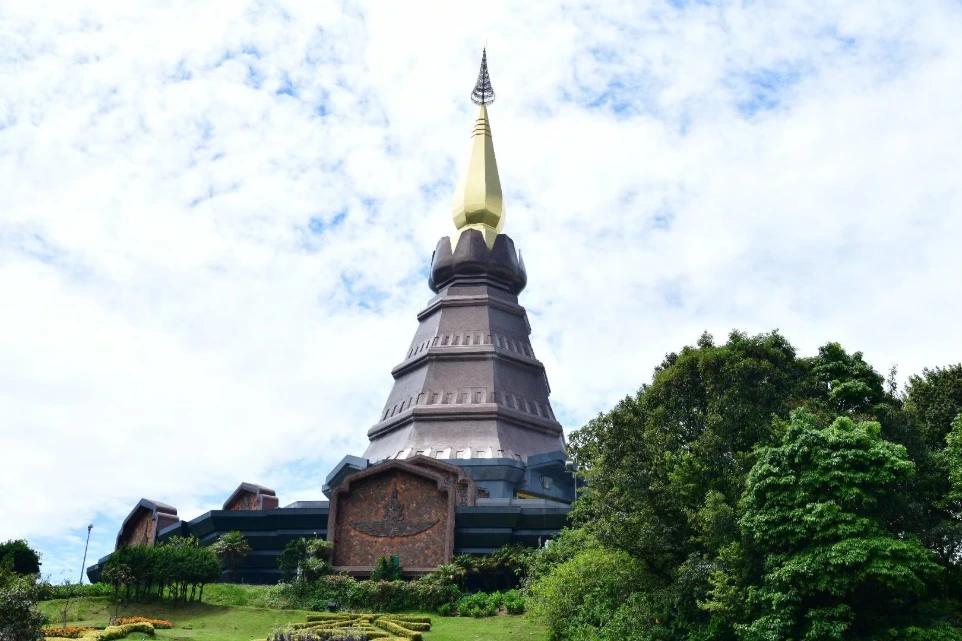
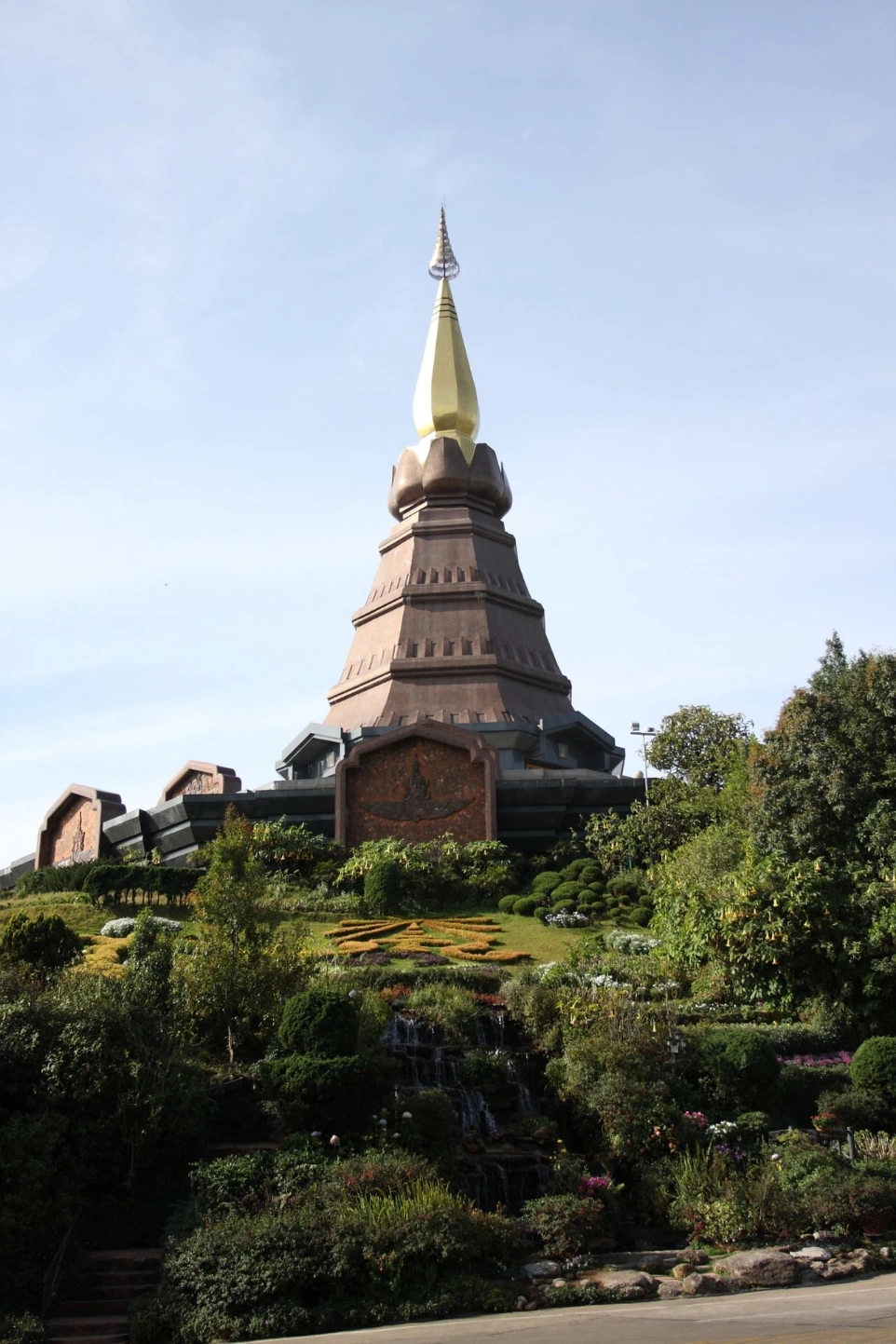
" The construction of the Royal Relic Stupa by the Royal Thai Air Force was undertaken as an act of profound devotion, respectfully dedicated as a royal merit-making offering. The stupa was graciously bestowed with the name “Phra Maha Thatthaphametthadol,” as humbly requested by the Royal Thai Air Force. The name may be interpreted to mean “the great sacred stupa enshrining the Lord Buddha’s relics, magnificent from the heavens to the earth."
Steering Committee for the Construction of the Phra Maha That Chedi
Historical Background
On 27 March B.E. 2530 (1987), the Royal Thai Air Force marked its 72nd anniversary. In the same year, on 5 December, His Majesty King Bhumibol Adulyadej attained the auspicious milestone of his Fifth Cycle Birthday Anniversary (60 years of age). In recognition of these significant occasions, Air Chief Marshal Praphan Dhupatemiya, then Commander-in-Chief of the Royal Thai Air Force, together with senior officers and civil servants of the Royal Thai Air Force, unanimously resolved to contribute funds for the construction of a commemorative monument. The initiative was undertaken both to mark the historic milestone of the Royal Thai Air Force and to dedicate the merit accrued therefrom as a royal offering in celebration of this most auspicious occasion.
In contemplating a commemorative monument worthy of generating the highest royal merit befitting the Fifth Cycle Birthday Anniversary—and in honor of the forthcoming date of 2 July B.E. 2531 (1988), which would mark the longest reign in Thai history—the Royal Thai Air Force determined that no undertaking would be more appropriate than the construction of a Royal Relic Stupa enshrining the sacred relics of the Lord Buddha. It was widely recognized among the people of the Kingdom that, in addition to His Majesty’s role as the Supreme Patron of all religions, he had steadfastly upheld and fostered the prosperity and enduring stability of Buddhism to an unparalleled degree. Moreover, His Majesty demonstrated profound personal devotion to the Buddhist faith, not only through material offerings but also through dedicated spiritual practice and meditation undertaken with genuine commitment and attainment.
Accordingly, the construction of the Royal Relic Stupa by the Royal Thai Air Force, dedicated as a royal act of merit, was regarded as the most fitting expression of gratitude and loyalty in honor of His Majesty’s boundless benevolence. Though such an undertaking could never be commensurate with His Majesty’s immeasurable virtue and moral authority—radiating across the land and reaching the heavens—the Royal Thai Air Force resolved that the sacred monument should be situated at the highest elevation within the Kingdom accessible for construction. Such placement would symbolize the exalted nature of His Majesty’s compassion, benevolence, and purity, which reside at the highest place both upon the land and within the hearts of the Thai people.
The Royal Thai Air Force therefore selected a peak on Doi Inthanon, the highest mountain in Thailand, as the site for the construction of the Royal Relic Stupa. Subsequently, upon formal request by the Royal Thai Air Force, His Majesty graciously bestowed upon the stupa the royal name “Phra Maha Thatthaphametthadol,” signifying “the Great Sacred Stupa enshrining the Lord Buddha’s relics, majestic from the heavens to the earth.”
Derivation
In B.E. 2528 (1985), Air Chief Marshal Praphan Dhupatemiya, then Commander-in-Chief of the Royal Thai Air Force, conceived the initiative to construct a stupa on the grounds of Doi Inthanon for the enshrinement of sacred relics that had been entrusted to the Royal Thai Air Force. The principal objective was to provide an opportunity for Buddhist devotees to pay homage and perform acts of veneration.
To this end, he consulted Air Marshal Woranat Apichari, then Deputy Chief of Air Staff, and entrusted him with the responsibility of identifying a suitable construction site. In late November of that year, Air Marshal Woranat, accompanied by Air Vice Marshal Prasert Datchukorn of the Royal Thai Air Force Headquarters; Group Captain Prasat Thaweesuk, Chief of the Mapping and Land Division, Directorate of Logistics, Royal Thai Air Force; and two architects from the Ministry of Public Health, Mrs. Khai Sri Tansiri and Mr. Tanti Chaisombat, traveled to Doi Inthanon to conduct a site survey. The survey was guided by Group Captain Watchara Yukatanan, then Commander of the Doi Inthanon Control and Reporting Center.
The exploratory team evaluated locations previously identified as potentially suitable, taking into account several key considerations: the aesthetic prominence of the stupa upon completion, the surrounding landscape, and accessibility for pilgrims traveling via the Chom Thong–Inthanon Road. Two potential sites were shortlisted, both situated on small hilltops running parallel to the Chom Thong–Inthanon Road, approximately at the fourth kilometer marker on the left-hand side.
The first site, located at the lower end of the ridge, offered exceptional visual prominence; a stupa constructed there would have been visible from a considerable distance and was situated close to the main road. However, the ridge at this point was narrow, thereby severely limiting the available construction area. Consequently, the team proceeded to evaluate a second site along the same ridge, positioned further upslope yet still within reasonable proximity to the road. This second location provided a sufficiently broad area that could be suitably developed to accommodate the stupa.
After careful consideration, the survey team resolved to select the second site as the proposed construction location. It was further agreed that the Mapping and Land Division of the Directorate of Logistics, Royal Thai Air Force, would conduct a detailed survey to obtain comprehensive data for final determination and confirmation of suitability.
Authorization for Land Use and Construction
The construction of a stupa within the boundaries of Doi Inthanon National Park required prior authorization from the National Park Committee. In this regard, the Royal Thai Air Force submitted a formal request dated 10 February B.E. 2529 (1986) to the Director-General of the Royal Forest Department, seeking permission to utilize the selected site for the construction of the stupa, together with an access bridge, roadway, and parking area. The total requested area comprised approximately 18 rai, 2 ngan, and 45 square wah.
Subsequently, the Royal Forest Department forwarded the matter to the Chiang Mai Provincial Forestry Office for verification and review, in order to prepare documentation for consideration by the National Park Committee. Upon receipt of the required information, the matter was presented at the third meeting of the National Park Committee for the year 2529 (1986), held on 17 July 1986. The Committee resolved, in principle, to approve the Royal Thai Air Force’s proposal to construct a stupa enshrining the Lord Buddha’s relics at the requested location.
Further clarifications and additional details were later submitted by the Royal Thai Air Force to the Royal Forest Department on 5 September 1986. Thereafter, on 4 October 1986, the Royal Thai Air Force submitted an Environmental Impact Assessment (EIA) report for the proposed construction project within Doi Inthanon National Park to the Secretary-General of the National Environment Board for consideration.
On 20 January B.E. 2530 (1987), the National Environment Board formally notified the Director-General of the Royal Forest Department of its approval of the submitted report, including the proposed environmental mitigation measures and monitoring mechanisms.
Site Preparation, Land Development, and Construction of the Parking Area and Bridge
An advance operations unit consisting of seventeen personnel, led by Group Captain Sombiti Sukonthong, entered the designated construction area with eight units of heavy machinery. After establishing a temporary encampment at Kilometer 31 along the Chom Thong–Inthanon Road, the team commenced operations immediately.
In early May B.E. 2529 (1986), the Directorate of Civil Engineering, Royal Thai Air Force, received official authorization to proceed with the construction of the access road and parking area, as well as the cutting and grading of the hill designated for the stupa structure. Consequently, personnel and equipment were relocated to a temporary residential and operational site near the Highway Maintenance Unit at Kilometer 21 of the Chom Thong–Inthanon Road. The relocation was completed by approximately 20 May 1986.
Living and working conditions on the hillside were extremely challenging. During June, rainfall occurred almost daily, accompanied by strong winds reaching speeds of 40–50 knots. Persistent mist and rainfall required personnel to wear cold-weather clothing throughout the day. On rainy days, workers sought shelter in temporary structures erected on site. The operation of heavy machinery under such conditions posed significant safety concerns. Fuel supply presented additional logistical difficulties, as it had to be manually transported by carriers from the roadside up the hillside. The temporary access track became slippery and hazardous, preventing vehicles from descending safely for refueling.
The construction phase engaged approximately ten technical personnel and twelve laborers, supported by around twenty-five supervisory staff. Work commenced daily at 7:30 a.m. and concluded at 5:00 p.m., although extended hours until 8:00 p.m. were occasionally required when tasks remained unfinished. Rainfall during this phase was less severe and did not substantially hinder operations.
Foundation excavation began with the first footing, followed by the pouring of concrete foundations and the erection of supporting columns for the bridge deck. Work progressed sequentially through the first, second, and third foundations, culminating with the fourth and final footing. Upon completion of each excavation, steel reinforcement grids were installed within the foundation pits. These prefabricated steel grids, each measuring approximately 2.5 meters in width and 7 meters in length, had been assembled in advance. Due to their considerable size and weight—requiring approximately eight personnel to lift manually—tracked excavators were utilized for hoisting operations.
The lifting process demanded exceptional care, as the steel grids, suspended by wire slings from the elevated arm of the excavator, could sway if improperly balanced. After careful coordination among the engineering personnel, each reinforcement grid was successfully hoisted and transported approximately 20 meters for precise placement within its respective foundation pit.
Symbolism of Form and Architectural Composition
In B.E. 2528 (1985), Air Chief Marshal Praphan Dhupatemiya, then Commander-in-Chief of the Royal Thai Air Force, conceived the initiative to construct a stupa on Doi Inthanon for the enshrinement of sacred relics entrusted to the Royal Thai Air Force. The objective was to provide an opportunity for Buddhist devotees to pay homage and perform acts of veneration.
To this end, he consulted Air Marshal Woranat Apichari, then Deputy Chief of Air Staff, assigning him responsibility for identifying a suitable construction site. In late November of that year, Air Marshal Woranat, accompanied by Air Vice Marshal Prasert Datchukorn of the Royal Thai Air Force Headquarters; Group Captain Prasat Thaweesuk, Chief of the Mapping and Land Division, Directorate of Logistics; and two architects from the Ministry of Public Health, Mrs. Khai Sri Tansiri and Mr. Tanti Chaisombat, traveled to survey potential locations. The inspection was guided by Group Captain Watchara Yukatanan, then Commander of the Doi Inthanon Control and Reporting Center.
The survey team evaluated sites previously identified as potentially suitable, taking into account aesthetic prominence upon completion, harmony with the surrounding landscape, and accessibility for pilgrims traveling via the Chom Thong–Inthanon Road. Two locations situated on small ridgelines running parallel to the road—approximately at the fourth kilometer marker on the left-hand side—were shortlisted.
The first site, positioned at the lower end of the ridge, offered exceptional visual prominence and close proximity to the roadway, allowing the completed stupa to be visible from a considerable distance. However, the narrow crest of the ridge imposed significant spatial limitations for construction. Consequently, attention shifted to a second site along the same ridge, located further upslope yet still within convenient access from the road. This second location provided sufficient breadth to allow for appropriate land development and structural placement.
After careful consideration, the survey team resolved to select the second site as the designated construction area. It was further determined that the Mapping and Land Division of the Directorate of Logistics, Royal Thai Air Force, would conduct a comprehensive topographical survey to obtain detailed data for final confirmation of suitability.
Project Implementation
In B.E. 2528 (1985), Air Chief Marshal Praphan Dhupatemiya, then Commander-in-Chief of the Royal Thai Air Force, initiated the concept of constructing a stupa on Doi Inthanon for the enshrinement of sacred relics entrusted to the Royal Thai Air Force. The intention was to provide an opportunity for Buddhist devotees to pay homage and perform acts of veneration.
To advance this initiative, he consulted Air Marshal Woranat Apichari, then Deputy Chief of Air Staff, assigning him responsibility for identifying a suitable construction site. In late November of that year, Air Marshal Woranat, accompanied by Air Vice Marshal Prasert Datchukorn of the Royal Thai Air Force Headquarters; Group Captain Prasat Thaweesuk, Chief of the Mapping and Land Division, Directorate of Logistics; and two architects from the Ministry of Public Health, Mrs. Khai Sri Tansiri and Mr. Tanti Chaisombat, undertook a field survey to evaluate potential locations. The inspection was conducted under the guidance of Group Captain Watchara Yukatanan, then Commander of the Doi Inthanon Control and Reporting Center.
The survey team assessed sites previously identified as potentially appropriate, considering visual prominence upon completion, harmony with the surrounding landscape, and accessibility for pilgrims traveling via the Chom Thong–Inthanon Road. Two locations situated on small ridgelines running parallel to the road—approximately at the fourth kilometer marker on the left-hand side—were shortlisted.
The first site, positioned at the lower end of the ridge, offered exceptional visibility and proximity to the main road, allowing the completed stupa to be seen from a considerable distance. However, the narrow crest of the ridge significantly limited the available construction area. Consequently, the team evaluated a second site along the same ridge, located further upslope yet still within convenient access from the roadway. This second location provided sufficient breadth to allow for appropriate land development and structural placement.
After careful deliberation, the survey team resolved to designate the second site as the official construction area. It was further determined that the Mapping and Land Division of the Directorate of Logistics, Royal Thai Air Force, would conduct a comprehensive topographical and technical survey to obtain detailed data for final confirmation of the site’s suitability and to facilitate formal project implementation.
Timeline
Phramahathat Nabhamethanidol
First Feature
A timeline is a graphical representation on which important events are marked.
Latest Feature
A timeline is a graphical representation on which important events are marked.
First Feature
A timeline is a graphical representation on which important events are marked.
Latest Feature
A timeline is a graphical representation on which important events are marked.
First Feature
A timeline is a graphical representation on which important events are marked.
Latest Feature
A timeline is a graphical representation on which important events are marked.
Ready to bring your digital vision to life?
Let's collaborate to create innovative solutions that stand out in the digital landscape. Reach out today and let's build something extraordinary together.